Why Most Airlines Still Lose Control During Disruptions — And What the Architecture Looks Like When They Don't
Most disruption failures aren't operational. They're architectural. Here's what breaks during a high-frequency IROP cascade — and what a unified workflow looks like when it doesn't.
Daniel Llano
Airline Technology Strategist
Every airline has a disruption plan. Most of them fail in the same way.
Not because the plan is wrong. Not because the operations team isn't experienced. They fail because the systems underneath the plan weren't built to communicate with each other under pressure — and when a disruption cascades, that gap becomes visible immediately.
The anatomy of a disruption cascade
Take a high-frequency operation: 100+ daily flights, multiple bases, a mix of narrowbody rotations. A single weather event at a hub delays four aircraft. Those four aircraft are the next rotation for eight more flights. Within ninety minutes, you have twelve affected departures, several hundred disrupted passengers, and a coordination problem that spans ops control, ground handling, crew scheduling, and the call centre simultaneously.
Each of those teams is working. None of them is working from the same information.
Ops control sees the flight impact. Ground handling is managing gate reassignments on a separate system. Crew scheduling is working a rosterning tool that hasn't been updated with the revised departure times. The call centre is fielding inbound calls from passengers who received no proactive communication and have no self-service option to rebook.
This is not an edge case. This is the standard failure mode for disruption management across the industry.
Why the problem is architectural, not operational
The instinct is to address this with process: better communication protocols, clearer escalation paths, more coordination meetings during IROPs. These help at the margins. They don't solve the underlying issue.
The underlying issue is that most airline operations stacks were built to optimize normal operations. Disruption handling was added as a layer on top — a combination of manual coordination, legacy tools, and tribal knowledge. When volume increases or disruptions cascade, that layer collapses.
The specific failure points are consistent:
Fragmented data ownership. Ops control owns flight data. The PSS owns passenger records. Ground handling owns gate and resource data. There is no single system that holds all three simultaneously and updates in real time. Every coordination action requires someone to manually bridge between systems.
Reactive passenger communication. Most airlines communicate disruption information to passengers after internal coordination is complete. By that point, passengers have already called the contact centre, posted on social media, or queued at the gate. The communication arrives too late to reduce inbound volume.
No self-service recovery path. When a passenger's flight is disrupted, the default resolution path is the call centre or the airport desk. Both have finite capacity. During a large-scale IROP, both are overwhelmed within minutes. Passengers who could self-serve — accepting rebooking on the next available flight, for example — have no channel to do so without agent involvement.
Single-dashboard visibility gap. Operations managers are working across multiple screens and systems to get a complete picture of a disruption. Time spent aggregating information is time not spent making decisions.
What unified disruption management looks like
The architectural solution is not to replace the PSS or rebuild the operations stack. It's to build a coordination layer that sits above existing systems, integrates their data in real time, and automates the workflows that currently rely on manual handoffs.
In practice, this means four things working together:
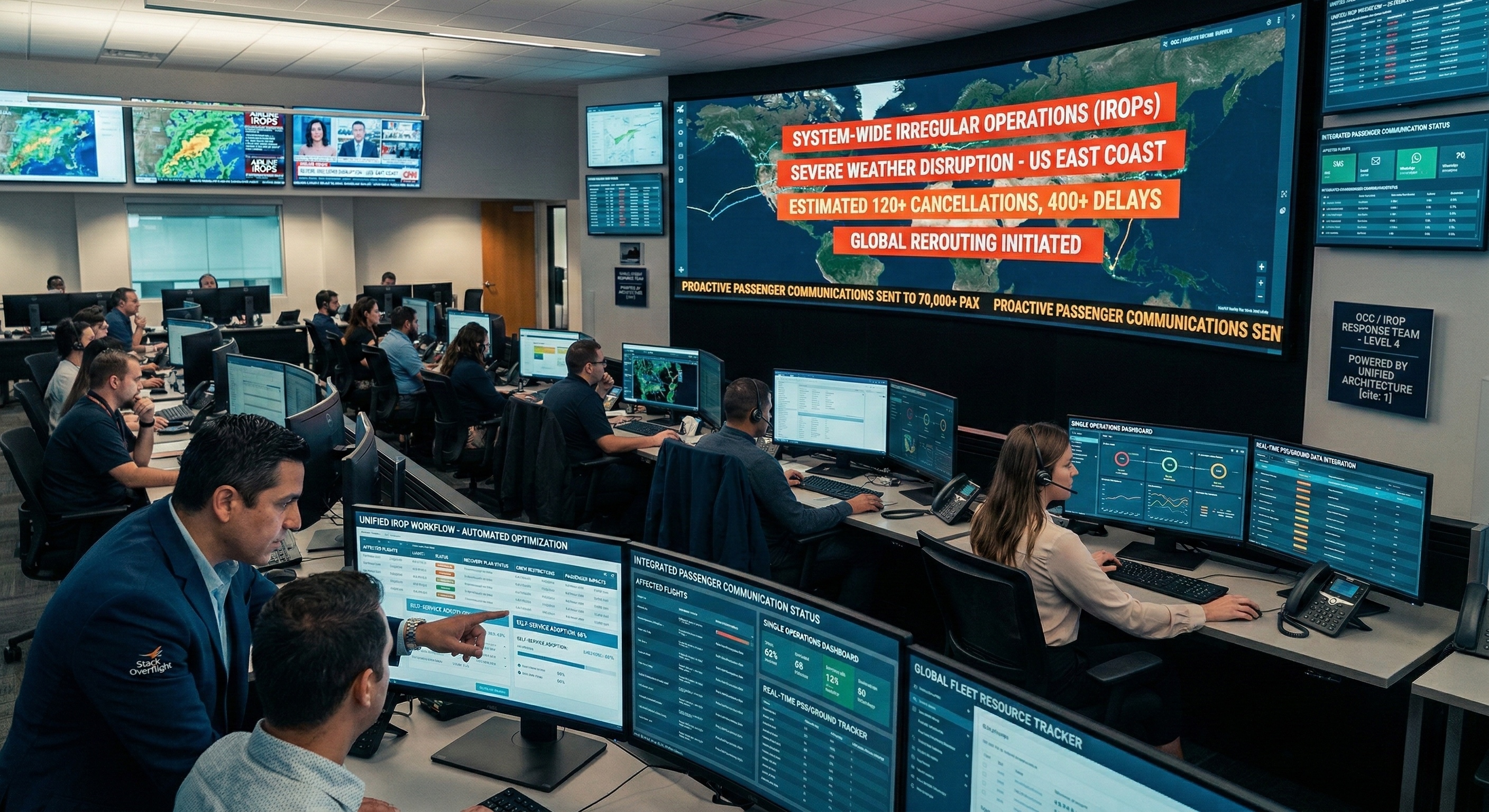
A unified IROP workflow engine. When a disruption is declared, the system automatically identifies all affected flights, passengers, and resources. It generates recovery options based on configurable business rules — rebooking logic, compensation thresholds, crew constraints — and surfaces them to the operations team in a single interface.
Automated proactive communication. The moment a disruption is confirmed, affected passengers receive structured communication through their preferred channel — app notification, SMS, email, or WhatsApp — with their specific situation, available options, and a direct link to act. This happens without agent involvement.
Passenger self-service portal. Disrupted passengers can view their options, accept rebooking, request compensation, or escalate to an agent — all without calling. The portal operates within the same business rules as the operations workflow, so passenger actions are automatically reflected in the ops view.
Single operations dashboard. The entire disruption — flights, passengers, crew, ground resources, communication status — is visible in one interface. Operations managers make decisions with complete information rather than assembling it from multiple systems.
What changes operationally
The impact of this architecture shows up in three measurable places.
Recovery time compresses significantly. When coordination is automated and information is centralized, the time between disruption declaration and full recovery action drops materially. Operations that previously took hours to stabilize resolve in a fraction of the time.
Inbound contact centre volume drops. Proactive communication and self-service options remove the primary driver of inbound calls during IROPs — passengers seeking information they don't have. Airlines that have deployed this architecture have seen inbound support volume during disruptions fall by half or more.
Passenger self-service adoption reaches scale. When a well-designed self-service option exists and passengers are directed to it proactively, adoption rates are high. The majority of disrupted passengers — in documented deployments, around 70% — resolve their situation without agent involvement when given a functional self-service path.
What to evaluate when assessing disruption management maturity
If you're assessing where your operation stands, the diagnostic questions are straightforward:
How many systems does an operations manager need to access to get a complete picture of an active disruption? More than one is a signal of fragmentation.
How long after a disruption is declared do affected passengers receive their first communication? If the answer is measured in hours, the communication workflow is manual.
What percentage of disrupted passengers resolve their situation without agent contact? If you don't know this number, you don't have self-service in place.
How long does it take to go from disruption declaration to full recovery actions being visible in a single view? If it requires coordination calls to answer, the visibility layer is missing.
None of these questions require a system replacement to address. They require an integration and workflow layer built specifically for disruption conditions — one that treats IROP management as a first-class operational problem, not an afterthought.
Ready to transform your operations?
Learn how Stack Overflight can help your airline modernize its digital infrastructure and operations.